




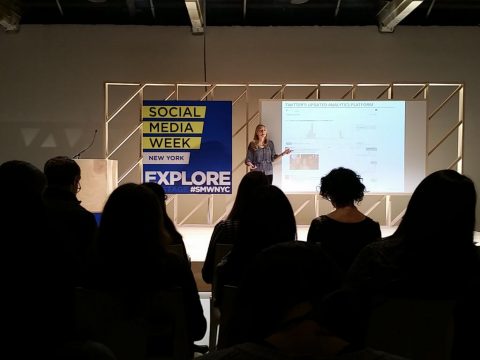
New York: This day was packed full of amazing seminars, my favorite was hosted by Trina Albus, Founder of Magenta Agency, about the death of organic reach and 5 tips on how to pay like a pro in our ever-changing social media landscape.
She broke down the top platforms brands and agencies should be concerned about and lent her advice. A must read for any social marketer in 2015.
For many social marketers, Facebook seems like a lost cause trying to get to your fans that you’ve spent so long building up. Organic reach is dead. Analytics at Ogilvy reported that pages have over 500.000 followers, will only reach 2 pct. of their audience.
Facebook has announced they are decreasing the amount of promotional content in feeds and for brands this puts the pressure to create content truly around what you’re fans would like to read in the very moment.
Your content strategy now needs to be considered apart of your Ad strategy to reach the same amount of people you used to be able to.
Advertising on Facebook
Traditionally, Facebook ads were made for B2C brands. B2B brands are still able to use the platform as long as they are creative. Previously, brands were only able to target ads based upon whether someone liked a company’s page.
But someone who likes Coca-Cola on Facebook may not be the best candidate for a CMO working for a competing beverage brand. Released in 2014, B2B Marketers are now able to refine searches by employer. This has made Facebook a viable option for reaching job candidates as well as advertising B2B-solutions. Facebook has also introduced the conversion tracking pixel that can insert a tracking code onto a target page on your website.
Twitter has rolled out their “While You Were Away” recap feature. Shows you tweets that they think are important to you. Very similar to Facebook’s algorithm, however the UX of the app for users is much easier to turn this option off.
Facebook is very persistent on creating tailored feeds. Even if you switch to the “Most Recent”, eventually Facebook will switch back to it’s tailored feeds by default.
Advertising on Instagram was just introduced in November 2013. Seeing these ads is very scarce. Instagram has only worked with a select group of big brands including Michael Kors, W Hotels and McDonald’s.
Pinterest introduced their Promoted Pins in September 2013 and started off similar to Instagram with just a few select big brands including Banana Republic, Gap and Lululemon.
Each brand had to commit to spending between $1 million to $2 million with $30 to $40 CPMs. They’ve now introduced the “self-serve” performance-based advertising platform to a any US based businesses.
If you haven’t been invited yet to the platform you can request to be put on the waitlist. A major improvement in the newer platform is that it will be CPC-based. The Sponsored Pins blend in very nicely with your Pinterest feed and most users don’t notice the difference.
The New Social Strategy in 5 Steps
• Define Your Target Demographic:
Whom are you trying to reach? Use organic reach data to figure out what’s working BEFORE shaping paid strategy.
• Define Your Goals:
What are you trying to accomplish?
• Decide Which Channels to Use:
Where is your target Demographic most active? Is advertising available on this channel? How much will you spend? For small social budgets, avoid spreading across platforms. Spend big on one to prove ROI, and then go from there.
• Define Your Metrics and KPIs:
How will you measure success? We should be careful using terms like reach and engagement. It’s now about end-goal (registrations, conversions).
• Execute Your Strategy:
Then Measure and refine. This is Trina Albus’ favorite tactic. You can try something new and have the data at your fingertips. If you are weary for example, to try out Promoted Pins, and it ends up not working out, you can shut it off. Organic reach may be dead, but you can still learn from your organic posts: Reuse copy that worked in organic feed.